Page 3 of 20
Bars and time
How a song is counted in bars and beats, and how to place a block in time.
Music is counted in bars. A bar is a small chunk of the song with a steady number of beats in it. In AMPLE every bar has four beats (you count "one, two, three, four, one, two..."). A song of eight bars has 32 beats.
How fast the beats go is the tempo, in beats per minute. The song of this guide has a tempo of 100: one hundred beats in a minute.
From bars to seconds#
If you know the tempo, you can work out how long a bar lasts:
| Tempo | One beat | One bar (4 beats) | Eight bars |
|---|---|---|---|
| 60 | 1 second | 4 seconds | 32 seconds |
| 100 | 0.6 seconds | 2.4 seconds | 19.2 seconds |
| 120 | 0.5 seconds | 2 seconds | 16 seconds |
The rule: a bar takes 4 × 60 ÷ tempo seconds.
Seeing the bars#
Open the Arrangement tab at the bottom of the window. It shows the song along a line of time. The numbers on the ruler on top are the bars, and the seconds are written underneath.

Every row is a block, and the coloured bar in it shows during which bars the block plays. Click the ruler and drag to choose some bars; the header then offers to play just those.
Placing a block in time#
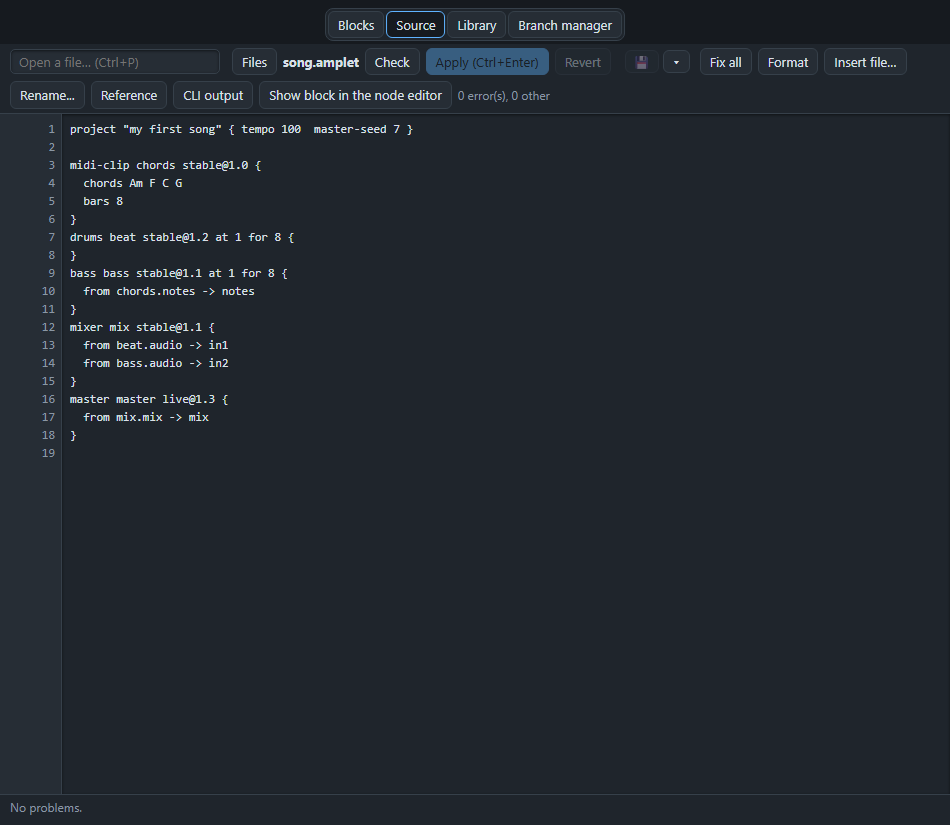
In the text, a block is placed with at and for:
bass bass stable@1.1 at 1 for 8 {This reads: start at bar 1 and last for 8 bars. A block that has no at simply takes the whole song. The first bar is bar 1, and bar 5 begins right after bar 4 ends.
You can give a block several places, and name them:
piano piano pinned@2.0 at 1 for 8 as verse, 9 for 8 as chorus {The piano now plays in two stretches, bars 1 to 8 and bars 9 to 16. Those named stretches are what music calls sections.
Steps: bars inside a bar#
For drums a bar is cut into 16 steps. Each step is a sixteenth of a bar, so every beat has four of them. In a drum pattern each step either has a hit (x) or stays quiet (.):
kick:x...x...x...x...This kick hits on steps 1, 5, 9 and 13: once on every beat.
Next: what happens when you press Build, Play and Stop, in Build, play and stop.